Showing posts with label Sciences. Show all posts
Showing posts with label Sciences. Show all posts
Friday, June 20, 2014

Wednesday, May 28, 2014


Tuesday, May 27, 2014
Saturday, April 26, 2014

Sunday, April 20, 2014
Percy Julians 115th Birthday
 | |
| Appeared On : | April 11, 2014 |
| Location : | United States |
If you are intrigued by today's doodle on the U.S. Google homepage, celebrating organic chemist, Dr. Percy Julian, I can provide no better recommendation than to watch the PBS documentary, Forgotten Genius, illustrating both his personal life and life's work.

It's no scientific revelation that it's the experiences from our everyday lives that inform our work, and in Dr. Julian's case, he used these experiences, overcoming tremendous challenges and racial barriers (and even a couple happy accidents) to become one of the most renowned and highly respected chemists in history.
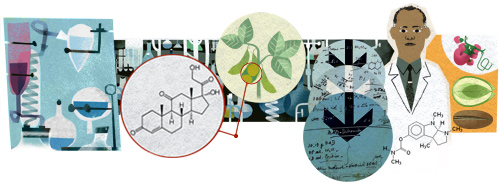
Visually, I was presented with a familiar challenge: to create something fun and engaging for us non-science types (I confess to finding a way of skipping chemistry in high school), while still calling attention to Julian's key achievements in an appropriate (ie. correct and validated!) way. Before getting too far into the research, I sketched thumbnails of the common association – that of a chemist in a lab full of beakers and tubes:
 As I read more about his work, I became fascinated with his process in the specific field of organic chemistry, and how he discovered ways to take rare and exotic components and synthesize them or discover alternate organic substances in place of more cost-prohibitive resources. Yep, that's a mouthful! So here are two key examples: His most well known triumph was the synthesis of the alkaloid, physostigmine, found in the african calabar bean, which led to a more readily available treatment of ailments such as glaucoma and Alzheimer's Disease. He also pioneered many uses from the soybean and soybean oil, developing a better process for obtaining cortisone to treat arthritis or to aid the body in the receiving of organ transplants. As I read more about his work, I became fascinated with his process in the specific field of organic chemistry, and how he discovered ways to take rare and exotic components and synthesize them or discover alternate organic substances in place of more cost-prohibitive resources. Yep, that's a mouthful! So here are two key examples: His most well known triumph was the synthesis of the alkaloid, physostigmine, found in the african calabar bean, which led to a more readily available treatment of ailments such as glaucoma and Alzheimer's Disease. He also pioneered many uses from the soybean and soybean oil, developing a better process for obtaining cortisone to treat arthritis or to aid the body in the receiving of organ transplants.
With these amazing feats in mind, I began to play with the idea of the chemical potential in plants, going as far as to have beakers growing on soy plants, or leaves growing out of metal tubes.

However, I decided clever metaphors (or just really bad puns) wasn't the best way to go. But I did want to maintain a lighter graphical treatment, hopefully appealing to young future scientists. Combining that aesthetic with something resembling diagrams out of a school textbook was the direction I took, which felt appropriate considering the obstacles Julian personally overcame in receiving his own education.
 Happy 115th birthday to the NOT Forgotten Genius, Dr. Percy Lavon Julian! Happy 115th birthday to the NOT Forgotten Genius, Dr. Percy Lavon Julian! | |

Saturday, April 12, 2014
Percy Julians 115th Birthday
| |
| Appeared On : | April 11, 2014 |
| Location : | United States |
If you are intrigued by today's doodle on the U.S. Google homepage, celebrating organic chemist, Dr. Percy Julian, I can provide no better recommendation than to watch the PBS documentary, Forgotten Genius, illustrating both his personal life and life's work.
It's no scientific revelation that it's the experiences from our everyday lives that inform our work, and in Dr. Julian's case, he used these experiences, overcoming tremendous challenges and racial barriers (and even a couple happy accidents) to become one of the most renowned and highly respected chemists in history.
Visually, I was presented with a familiar challenge: to create something fun and engaging for us non-science types (I confess to finding a way of skipping chemistry in high school), while still calling attention to Julian's key achievements in an appropriate (ie. correct and validated!) way. Before getting too far into the research, I sketched thumbnails of the common association – that of a chemist in a lab full of beakers and tubes:
As I read more about his work, I became fascinated with his process in the specific field of organic chemistry, and how he discovered ways to take rare and exotic components and synthesize them or discover alternate organic substances in place of more cost-prohibitive resources. Yep, that's a mouthful! So here are two key examples: His most well known triumph was the synthesis of the alkaloid, physostigmine, found in the african calabar bean, which led to a more readily available treatment of ailments such as glaucoma and Alzheimer's Disease. He also pioneered many uses from the soybean and soybean oil, developing a better process for obtaining cortisone to treat arthritis or to aid the body in the receiving of organ transplants.
With these amazing feats in mind, I began to play with the idea of the chemical potential in plants, going as far as to have beakers growing on soy plants, or leaves growing out of metal tubes.
However, I decided clever metaphors (or just really bad puns) wasn't the best way to go. But I did want to maintain a lighter graphical treatment, hopefully appealing to young future scientists. Combining that aesthetic with something resembling diagrams out of a school textbook was the direction I took, which felt appropriate considering the obstacles Julian personally overcame in receiving his own education.
Happy 115th birthday to the NOT Forgotten Genius, Dr. Percy Lavon Julian! | |
Friday, January 17, 2014
Dian Fosseys 82nd Birthday
 | |
| Appeared On : | Jan. 16, 2014 |
| Location : | Global |
One of the most amazing humans ever to have lived: Dian Fossey. I was incredibly honored to create a Google Doodle for her.

A very early concept sketch
Here's a fun fact though: I used to think her name was spelled Diane Fossy. It was an honest mistake, misplacing one little "e". Similarly, quite a few of our doodles start out with us knowing very little about the subject matter. And it's understandable to a degree, considering we create doodles for people, occasions, and things around the world. But I knew Dian was someone for whom I really needed to do my homework, so after correcting my spelling error and reading through her Wikipedia page, I ordered a copy of Gorillas in the Mist and dug in.
 the bigger story
I thought I was in for a dry, scientific journal, full of charts, data, and the inevitable bits of Latin. There's some of all of those things in there to be sure, but it is all perfectly woven into an engaging story, with the same range of emotional ups and downs of a classic novel. I laughed. I cried. I became angry. I was filled with hope. I cried some more. I was almost immediately drawn not just to the basis of her field work, but her greater cause to save the critically endangered mountain gorilla.

I also engaged The Dian Fossey Gorilla Fund International for their guidance. It never hurts to get the real experts involved. Dr. Erika Archibald provided some invaluable bits of advice, and by the end of our phone call, I had a pretty firm grasp on what to illustrate. The challenge was focusing on the importance of her work while managing to weave a narrative thread throughout the piece.
 breaking down the google letters
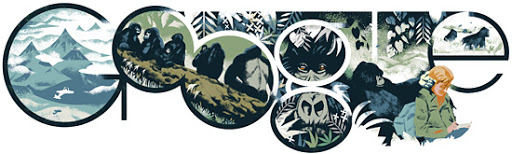
The big 'g' is based on the first time Fossey was flown over the Virunga mountains. At the time, there were only something like 200 mountain gorillas, all living in one mountain range, so this image juxtaposes the idea of a wide-open space with what is actually a very limited area for an entire species.
The double 'o's show the family structure of the gorillas, which was something Fossey really focused on: The family dynamic, how the group interacted with each other ... I really wanted to build that sense of family, so here you see juvenile gorillas, mature females, one with infant, and a silverback male." The lowercase 'g' is based on the first time she actually saw a mountain gorilla face-to-face – she could barely see it peering through the foliage. Although the moment wasn't an encounter with Digit, the gorilla that Fossey's most famously known for being attached to – I chose to make the gorilla resemble him, a nod to one of her dearest friends.  The 'l' is the moment where a gorilla reached out and touched her hair. It may not have been the first or only moment of contact – she writes in the book about how one actually snatched her journal away at one point – but it's an iconic moment captured on film and demonstrates her effectiveness in "habituating" with mountain gorillas. That is, being accepted into their group and to be able to roam among them. I wanted to leave the 'e' a little more spacious and open-ended, because first of all, there's already a lot going on in the illustration, but also because there's a lot of ambiguity left in the tale of the mountain gorilla. Their future at best continues to be uncertain. So you can look at it from a place of hope or worry. If 'e' were to stand for something, it could stand for 'endangered,' or it could stand for 'enduring.' It's up to us to place the right 'E' in the right place.
posted by Mike Dutton, Doodler
| |